

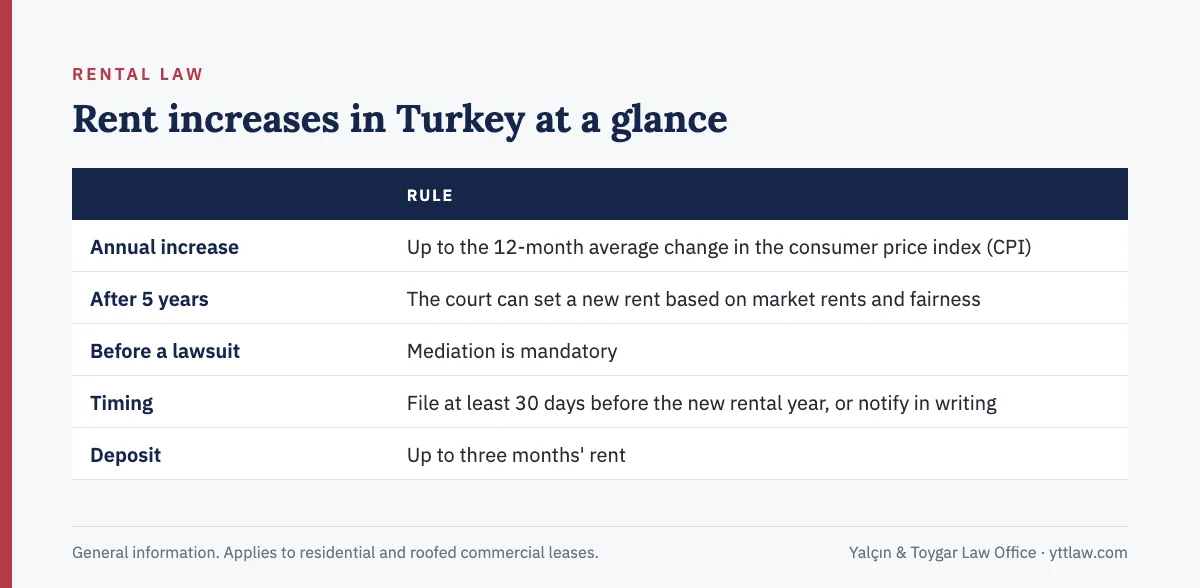
Short answer: For residential and roofed commercial leases in Turkey, the annual rent increase cannot exceed the 12-month average change in the consumer price index. After five years of tenancy, either party can ask the court to set a new rent in line with market rents. Mediation is mandatory before a rent determination case is filed. The same rules apply to foreign tenants and landlords.
The legal cap
Under Article 344 of the Turkish Code of Obligations, the rent for the renewed rental year cannot exceed the 12-month average change in the consumer price index for the previous rental year. A contract clause allowing a higher increase is not valid above this cap.
The five-year rule
When the tenancy reaches five years, and every five years after that, the judge can set the new rent by taking into account market rents for similar properties, the condition of the property and fairness. The CPI cap does not limit this determination.
Rent determination case
- Mediation: mandatory before the case is filed.
- Court: the civil court of peace where the property is located.
- Expert report: the court usually appoints an expert to assess market rents.
- Timing: if the case is filed at least 30 days before the new rental year, or the landlord notifies the tenant in writing within that period, the new rent applies from the start of that year.
Deposit
The security deposit for a residential lease cannot exceed three months’ rent. A cash deposit is placed in a savings account in a bank and can only be withdrawn with the consent of both parties or a court decision.
For our services in this field, see our real estate law page.
Frequently asked questions
Not during the first five years: the annual increase is capped at the 12-month CPI average. After five years, the court can set a market rent.
Yes. Either the landlord or the tenant can ask the court to determine the rent.
Yes. Mediation is a precondition for lawsuits arising from lease relationships, including rent determination.
Yes. The Turkish Code of Obligations applies to leases of property in Turkey regardless of the parties’ nationality.
This article is for general information only and does not constitute legal advice. Every case depends on its own facts; please consult a lawyer about your situation. Last reviewed: November 2026.