

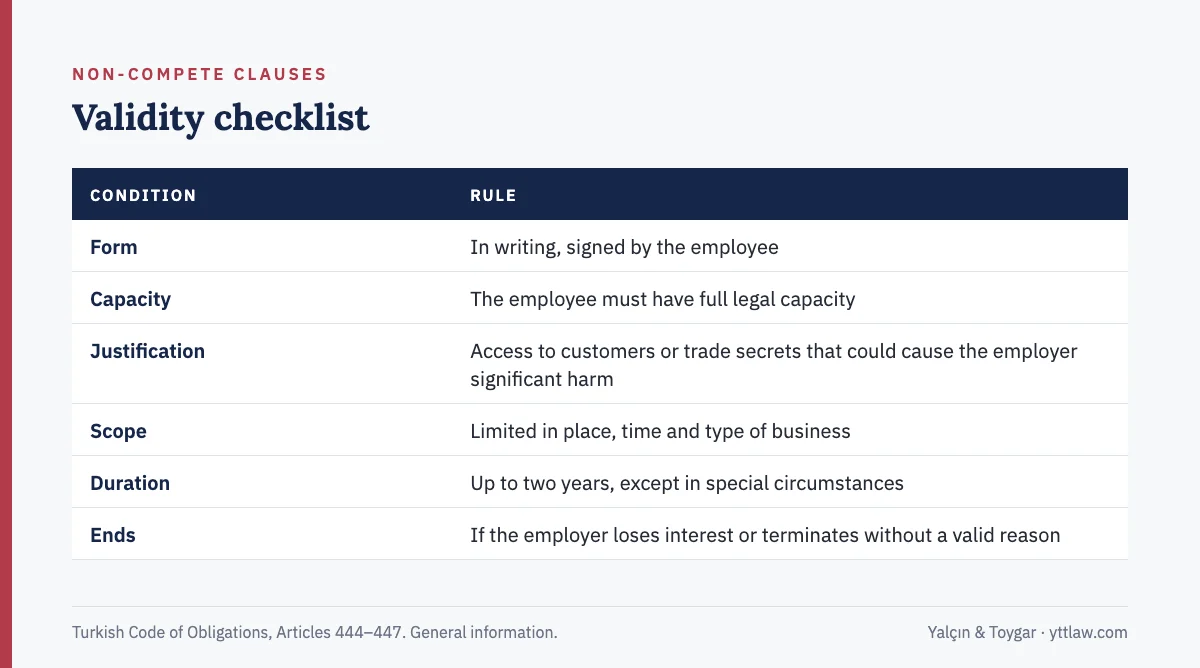
Short answer: A non-compete clause in a Turkish employment contract is valid only if it is in writing, the employee had access to the customer base or trade secrets, and the clause is limited in place, time and type of work. As a rule it cannot exceed two years after the employment ends. Judges can narrow an excessive clause, and the clause falls away if the employer dismisses the employee without a valid reason.
Foreign companies hiring in Turkey often copy the non-compete clause from their group template. Under Turkish law, broad clauses written that way are frequently narrowed or set aside. The rules are in Articles 444 to 447 of the Turkish Code of Obligations.
When is the clause valid?
The employee must have had insight into the customer base or the employer’s production or business secrets, and using that knowledge must be capable of causing the employer significant harm. A receptionist or warehouse worker rarely meets that test. A sales manager with key accounts usually does.
Limits on scope
The clause must not unfairly endanger the employee’s economic future. It has to be limited in:
- place, for example a city or region where the employer actually operates;
- time, which cannot exceed two years except in special circumstances;
- type of business, meaning the employer’s actual field of activity.
If the clause is excessive, the judge can reduce its scope or duration, taking into account any compensation the employer paid for it.
When does it end?
The restriction lapses if the employer no longer has a real interest in enforcing it. It also lapses if the employer terminates the contract without a valid reason, or if the employee resigns for a reason attributable to the employer.
Penalty clauses and enforcement
Contracts often include a contractual penalty for breach. If only a penalty is agreed, the employee can generally pay it and be released, unless the contract says otherwise. The employer may also ask for damages beyond the penalty if it proves greater harm, and in some cases may seek an order stopping the competing activity. Courts reduce penalties they consider excessive.
For employers
- Draft the clause for the specific role rather than using a group-wide template.
- Name the territory and the business lines precisely.
- Consider paying for the restriction; it improves the chances of enforcement.
See also severance pay in Turkey and our employment law page.
Frequently asked questions
Turkish law does not require payment for validity, but compensation is taken into account when a judge decides whether the clause is excessive.
Only in special circumstances. As a rule, the restriction cannot exceed two years after the employment ends.
If the employer terminated without a valid reason, the restriction lapses. If the termination was for a valid reason, it may still apply.
It depends on the wording and on whether you gained insight into those customers through your job. The clause must be limited to what protects a legitimate interest of the employer.
This article is for general information only and does not constitute legal advice. Every case depends on its own facts; please consult a lawyer about your situation. Last reviewed: November 2026.