

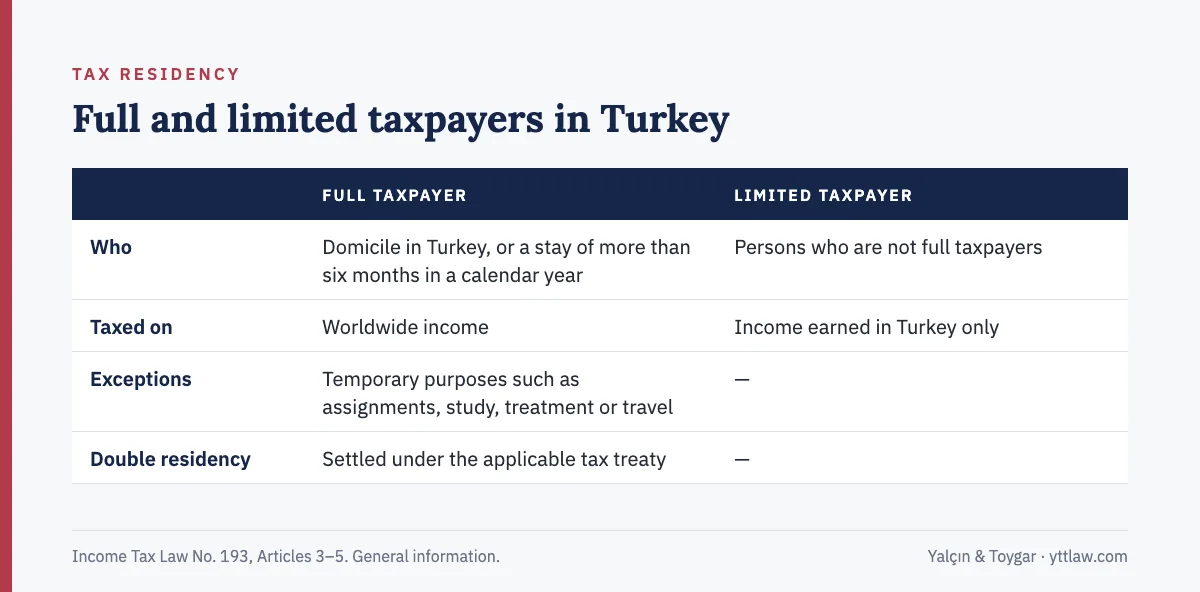
Short answer: Under the Turkish Income Tax Law, a person is a full taxpayer, taxed on worldwide income, if their domicile is in Turkey or if they stay in Turkey for more than six continuous months in a calendar year. Temporary departures do not interrupt the six-month period. Foreigners who come for a specific, temporary purpose, such as a work assignment, study, medical treatment or travel, are not treated as residents even if they stay longer. Other foreigners are limited taxpayers, taxed only on income earned in Turkey.
The two tests
- Domicile: a person whose domicile, as defined in the Turkish Civil Code, is in Turkey is a full taxpayer. Domicile is the place where a person stays with the intention of settling.
- Six-month stay: a person who stays in Turkey for more than six continuous months in one calendar year is a full taxpayer. Temporary trips abroad do not break the period.
Exceptions
Article 5 of the Income Tax Law lists persons who are not considered resident even if they stay in Turkey for more than six months, provided they came for a specific and temporary purpose. These include business people, scientists, technicians, officials and journalists on a temporary assignment, as well as people who come for education, medical treatment, rest or travel.
What changes for a full taxpayer?
- Income from all countries, including salaries, rents and investment income abroad, falls within the scope of Turkish income tax.
- Tax paid abroad can, within legal limits, be credited against Turkish tax on the same income.
- A limited taxpayer is taxed only on income earned in Turkey, such as rent from a property in Turkey.
Double residency and tax treaties
A person can be resident in Turkey and in another country at the same time under their domestic laws. Turkey has double taxation treaties with many countries. These treaties decide which country is the residence country, usually by looking at the permanent home, centre of vital interests, habitual abode and nationality in that order. A tax residency certificate issued by the relevant tax authority is used to apply treaty benefits.
Practical points
- A residence permit and tax residency are different concepts; holding a residence permit does not on its own decide tax residency.
- Records of entry and exit dates are important evidence for the six-month test.
- Rental income from property in Turkey may require a tax return even for limited taxpayers.
For our services in this field, see our tax law page.
Frequently asked questions
Not by itself. Tax residency depends on domicile or a stay of more than six continuous months in a calendar year, subject to the exceptions in the Income Tax Law.
No. Temporary departures do not interrupt the six-month period.
If there is a tax treaty between Turkey and the other country, the treaty’s tie-breaker rules decide residency. Without a treaty, both countries may tax under their own laws, with credit for foreign tax within limits.
A tax residency certificate can be requested from the Turkish tax administration for the relevant year.
This article is for general information only and does not constitute legal advice. Every case depends on its own facts; please consult a lawyer about your situation. Last reviewed: November 2026.