

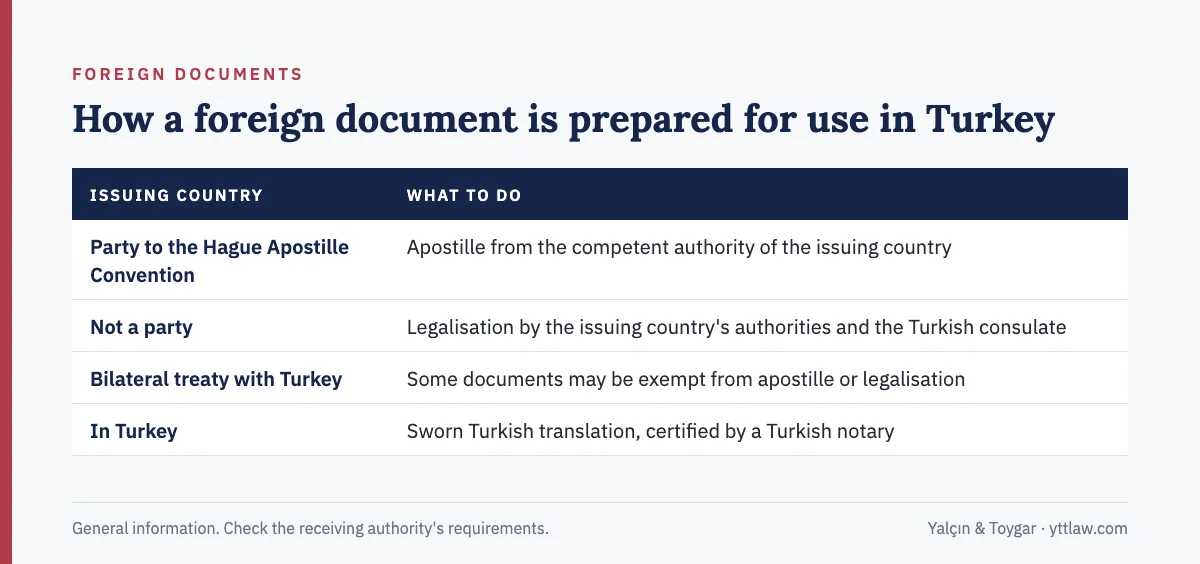
Short answer: A public document issued abroad, such as a birth certificate, marriage certificate, court decision or company record, must usually be apostilled before it is used in Turkey if the issuing country is a party to the Hague Apostille Convention. Documents from other countries need consular legalisation. In Turkey, the document is then translated into Turkish by a sworn translator registered with a notary, and the translation is certified by the notary.
What an apostille does
Turkey is a party to the 1961 Hague Convention abolishing the requirement of legalisation for foreign public documents. An apostille confirms the signature and seal on a public document so that the document is accepted in other member countries without further legalisation. It does not confirm the content of the document.
Which documents usually need it?
- Civil status documents: birth, marriage, divorce and death certificates
- Court decisions, including divorce judgments to be recognised in Turkey
- Company documents: certificate of good standing, board resolutions, signature declarations
- Notarised powers of attorney signed abroad
- Diplomas and criminal record certificates for work permit or citizenship files
Countries outside the Convention
If the issuing country is not a party, the document is legalised by that country’s competent authorities and then by the Turkish consulate. Bilateral treaties between Turkey and some countries may exempt certain documents from these formalities.
Sworn translation and notarisation
After the apostille, the document and the apostille itself are translated into Turkish by a sworn translator registered with a Turkish notary. The notary then certifies the translator’s signature. Some authorities also accept translations certified by a Turkish consulate abroad.
Turkish documents to be used abroad
In Turkey, apostilles for administrative documents are issued by governorships and district governorships, and for judicial documents by the justice commissions of first instance courts. Notarised documents are apostilled by the district governorship.
Practical tips
- Check how recent the document must be; some authorities accept documents only for a limited period.
- Names should be spelled consistently in all documents and translations.
- Ask the receiving authority whether it needs the original or a certified copy.
For help with documents from abroad, see our online legal consultancy page.
Frequently asked questions
Yes. In Turkey, both the document and the apostille are usually translated into Turkish by a sworn translator.
The apostille itself does not expire, but the receiving authority may ask for a recently issued document.
Yes. A lawyer can arrange the sworn translation and notarisation once the apostilled original is received.
The document should be legalised by your country’s authorities and then by the Turkish consulate, unless a bilateral treaty provides otherwise.
This article is for general information only and does not constitute legal advice. Every case depends on its own facts; please consult a lawyer about your situation. Last reviewed: November 2026.