

Short answer: A foreign national can apply for Turkish citizenship after making a qualifying investment, such as buying real estate worth at least USD 400,000 and keeping it for three years, or holding at least USD 500,000 in a Turkish bank deposit or government bonds for three years. The investment is first confirmed by the relevant authority with a certificate of conformity. The investor then obtains a residence permit and applies for citizenship; the final decision is made by the Presidency.
Which investments qualify?
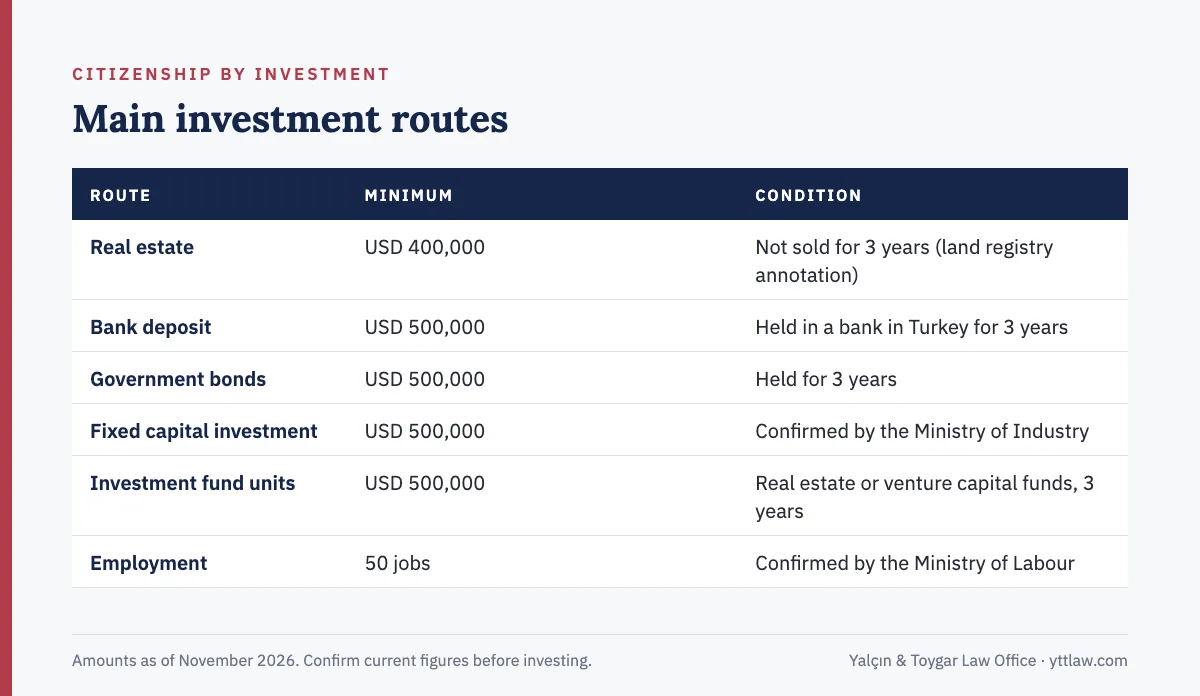
The Regulation on the Implementation of the Turkish Citizenship Law sets out the qualifying investments. The main routes used by foreign investors are:
- Real estate: purchase of property worth at least USD 400,000, with an annotation in the land registry that it will not be sold for three years.
- Bank deposit: at least USD 500,000 (or the equivalent in foreign currency or Turkish lira) held in banks operating in Turkey for three years.
- Government debt instruments: at least USD 500,000 in government bonds held for three years.
- Fixed capital investment: at least USD 500,000, confirmed by the Ministry of Industry and Technology.
- Fund units: at least USD 500,000 in real estate investment fund or venture capital investment fund units held for three years.
- Employment: creating jobs for at least 50 people, confirmed by the Ministry of Family, Labour and Social Services.
Amounts and conditions can change by Presidential decision. The current figures should be confirmed with the competent authorities before an investment is made.
Step by step
- Make the investment through a Turkish bank. For real estate, the price is paid by bank transfer, the foreign currency is converted and a currency conversion certificate is obtained, and an official valuation report is prepared.
- Obtain the certificate of conformity. For real estate, it is issued by the General Directorate of Land Registry and Cadastre; for deposits and bonds, by the Banking Regulation and Supervision Agency or the relevant authority.
- Obtain a residence permit based on the investment.
- Apply for citizenship with the required documents, including translated and apostilled civil status documents for the applicant, spouse and children under 18.
- Security review and decision. The file is reviewed and the decision is made by the Presidency. After approval, the identity card and passport are issued.
Common reasons for delay
- A valuation report below the threshold, or a property bought from a seller who is not eligible under the rules.
- Payments that were not made through a bank or were not converted correctly.
- Missing or untranslated civil status documents.
- Inconsistencies between names in passports, birth certificates and marriage certificates.
For our services in this field, see our immigration and citizenship law page.
Frequently asked questions
After the certificate of conformity and the residence permit are obtained, the citizenship decision usually takes several months. The total time depends on the investment route, the completeness of the documents and the security review.
Yes. The spouse and children under 18 can be included in the same application. Their civil status documents must be apostilled and translated into Turkish.
The land registry annotation requires the property to be kept for three years. Selling earlier can put the citizenship granted on the basis of that investment at risk.
No residence period is required for the investment route. A residence permit based on the investment is obtained as part of the process.
This article is for general information only and does not constitute legal advice. Every case depends on its own facts; please consult a lawyer about your situation. Last reviewed: November 2026.