

Short answer: A foreigner can make a will in Turkey before a notary (an official will) or entirely by hand (a handwritten will). The inheritance of a foreigner is generally governed by the law of their nationality, but real estate located in Turkey is always subject to Turkish law. Turkish law protects close relatives with reserved shares, so a will that leaves property in Turkey to someone else can be reduced by a court if the heirs object.
Which law applies?
Under Article 20 of the Turkish International Private and Procedural Law, inheritance is governed by the national law of the deceased. There is one important exception: real estate in Turkey is subject to Turkish law. A British or German citizen with a flat in Antalya and bank accounts at home may therefore have two legal systems applying to one estate.
Forms of a will
- Official will: made before a notary (or a civil judge of peace) with two witnesses. It is the safest choice for a foreigner, and the notary keeps a copy.
- Handwritten will: written entirely by hand by the testator, with the day, month and year, and signed. Typed text or a missing date can make it invalid. It can be deposited with a notary for safekeeping.
- Oral will: allowed only in extraordinary situations, such as imminent danger of death, before two witnesses.
A will made abroad is valid in form in Turkey if it meets the formal rules of, among others, the place where it was made, the testator’s nationality or domicile, or, for real estate, the place where the property is located. Turkey is a party to the 1961 Hague Convention on the form of wills.
If you do not speak Turkish, a sworn interpreter attends the notary appointment, and the will is drafted in Turkish with a translation.
Reserved shares
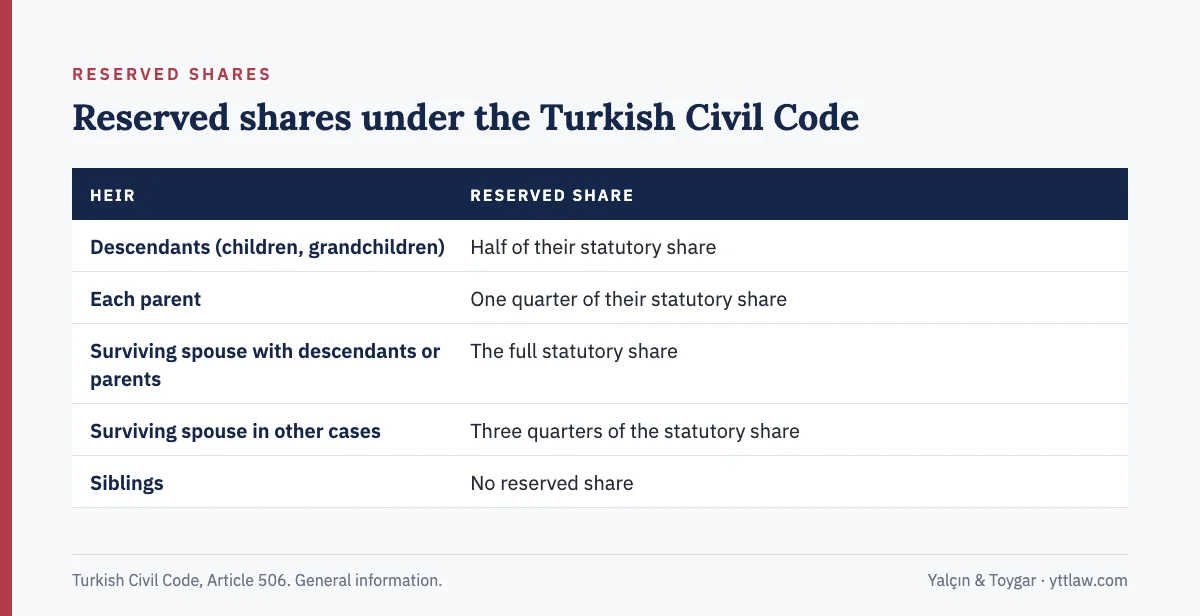
The table above shows how much of each heir’s statutory share is protected. You can freely dispose of what remains. If a will goes beyond that limit, the protected heirs can file a reduction action within one year of learning that their share was violated, and in any case within ten years of the will being opened.
After death
The will must be delivered to the civil court of peace, which opens it and notifies the heirs. A certificate of inheritance is then issued and the property is transferred at the land registry. An heir who wants to challenge the validity of the will has one year from learning of it, and ten years at most.
For related topics, see Can a foreigner inherit property in Turkey?
Frequently asked questions
It is not required, but a Turkish will for Turkish property is often easier to apply, because the land registry and courts work with Turkish documents and Turkish law applies to the real estate anyway.
Only within the limits of the reserved shares. Children are entitled to half of their statutory share, and they can ask the court to reduce the will if this is violated.
A handwritten will can be valid in any language if all formal rules are met. In practice, a notarised will in Turkish with a translation avoids disputes.
Yes. A will can be revoked or replaced at any time by a new will made in one of the legal forms.
This article is for general information only and does not constitute legal advice. Every case depends on its own facts; please consult a lawyer about your situation. Last reviewed: November 2026.