

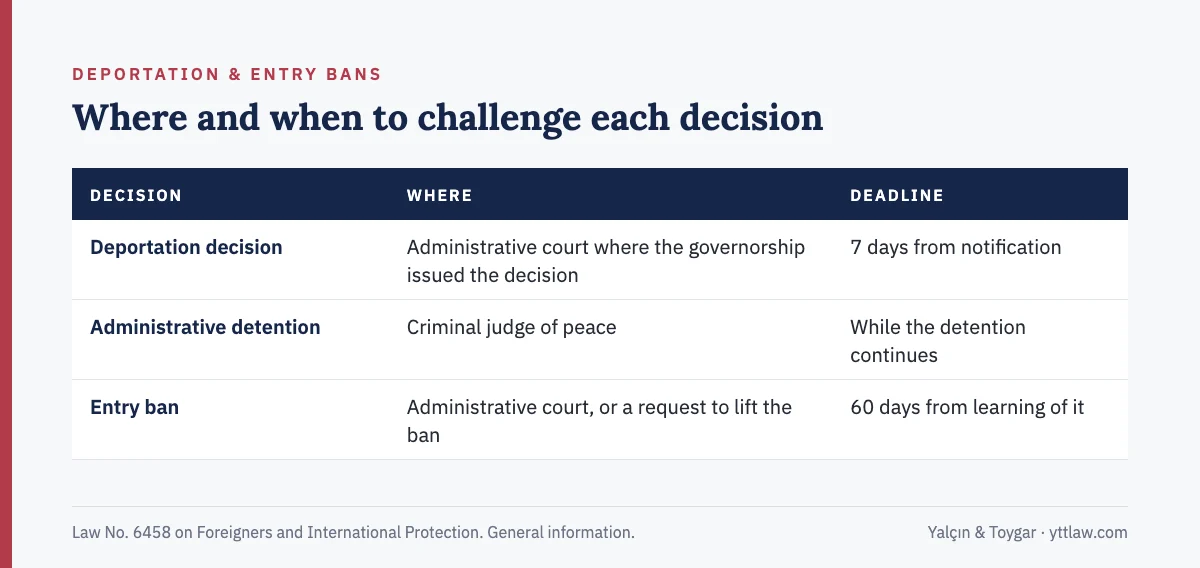
Short answer: A deportation decision in Turkey can be challenged before the administrative court within 7 days of notification. While that period runs and while the case is pending, the person is generally not removed unless they agree to leave. The court decides within 15 days and its decision is final. An entry ban is a separate measure: it usually lasts up to five years and can be lifted, or suspended for a specific visit.
Who issues a deportation decision?
Deportation decisions are issued by the governorship of the province, on behalf of the Presidency of Migration Management. The grounds are listed in Article 54 of Law No. 6458. The most common ones in practice are overstaying a visa or residence permit, working without a work permit, using false documents, and being considered a threat to public order, public security or public health. A residence permit that is cancelled or not renewed can also lead to a decision if the person does not leave.
The 7-day deadline
The decision must be notified to the person, together with the reasons. From that date, the foreigner, their legal representative or their lawyer has 7 days to file a lawsuit at the administrative court. The court must decide within 15 days, and there is no appeal against its judgment.
Seven days is short. A lawyer needs the decision, the notification record and the person’s documents (passport, residence permit history, any family or work ties in Turkey) as early as possible. Family ties, a pending residence application or a health problem are all relevant to the court’s assessment.
Is the person removed while the case continues?
As a rule, no. The law says the foreigner is not removed during the 7-day period or while the lawsuit is pending, unless they consent to leave. For some grounds related to terrorism and public security, this protection is narrower, so the ground written in the decision matters.
The law also lists people who cannot be deported even when a ground exists, for example where there is a serious risk of the death penalty, torture or inhuman treatment in the destination country, or where travel is unsafe because of serious illness, age or pregnancy.
Removal centres and administrative detention
A person facing deportation may be placed under administrative detention in a removal centre. Detention cannot exceed six months, and in limited cases, such as failure to cooperate, it can be extended by up to six more months. The detained person, their representative or lawyer can apply to the criminal judge of peace against the detention at any time.
Entry bans
An entry ban is recorded in the migration system with a restriction code. The code shows the reason, for example a visa overstay or a security ground, and it decides how the ban can be addressed. Entry bans generally last up to five years. Where there is a serious threat to public order or security, they can be extended by up to ten more years.
- A ban can be challenged with an administrative lawsuit, usually within 60 days of learning of it.
- The authority can lift a ban, or allow entry for a limited period without lifting it, for example for a court hearing or a family reason.
- Many people only learn of a ban when a visa is refused or at the border. Checking the restriction code through a lawyer before travelling avoids a wasted trip.
Overstays
Foreigners who overstay usually pay an administrative fine when leaving. Depending on the length of the overstay and how the person leaves, an entry ban may follow. Leaving voluntarily and paying the fine generally leads to a better outcome than being caught during a check.
For our services in this field, see our immigration law page.
Frequently asked questions
As a rule, yes. The law prevents removal during the 7-day period and while the court case continues, unless you agree to leave. For some security-related grounds, this protection is narrower.
Bans are recorded with a restriction code in the migration authority’s system. A lawyer in Turkey can check the code and its reason before you travel or apply for a visa.
Yes. The authority can lift a ban or allow entry for a limited period. A request is stronger when it is supported by documents such as family ties, a pending court case or a paid fine.
Yes. The court decides within 15 days and its judgment on the deportation decision cannot be appealed.
This article is for general information only and does not constitute legal advice. Every case depends on its own facts; please consult a lawyer about your situation. Last reviewed: November 2026.